FEAGINE Feagine Ego Data
Turning every human action into an experience a machine can learn from.
Converting natural real-world operations into embodied data that is trainable, evaluable, and transferable across embodiments.
Not just recording what happened. Understanding how the action happened.
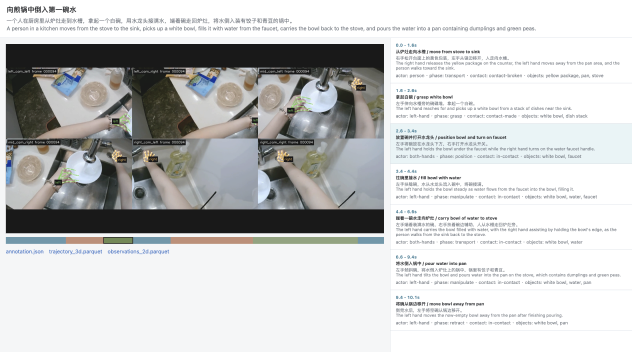
Ordinary video only records footage. Feagine data simultaneously preserves vision, motion, hand trajectories, contact relations, task phases, and semantic context—turning continuous human operation into structured embodied-learning samples.
Every delivered Episode undergoes automated detection and manual review. We retain only data with complete video, aligned timestamps, visible operation,
stable hand recognition, continuous 3D trajectories, and stable back-projection.
*The hand skeleton in delivered footage is generated by directly projecting metric 3D hand trajectories using the intrinsic/extrinsic parameters of the six-camera rig, rather than from an independent 2D detection. As a result, the numerical discrepancy between 3D data and delivered visualization is close to zero.
Capture is only the beginning.
From raw multimodal signals to structured Episodes ready to feed directly into a model pipeline.
Record authentic human operations
Unify timelines across multi-camera, IMU, and metadata streams
Recover hand keypoints, 3D trajectories, and spatial relations
Identify task phases, action semantics, and interaction objects
Detect occlusion, drift, trajectory anomalies, and annotation inconsistency
Convert human experience into training representations usable by different robots
Record authentic human operations
Unify timelines across multi-camera, IMU, and metadata streams
Recover hand keypoints, 3D trajectories, and spatial relations
Identify task phases, action semantics, and interaction objects
Detect occlusion, drift, trajectory anomalies, and annotation inconsistency
Convert human experience into training representations usable by different robots
Recording action itself, from the human point of view.
Using a head-mounted multi-camera sensing system, we synchronously capture multi-view vision, inertial motion, head pose, hand state, unified timestamps, and task metadata during natural operation.
One experience, many embodiments.
Decoupling task intent, end-effector trajectories, action phases, and contact relations from a specific embodiment, so they can be retargeted to robots with different link lengths, degrees of freedom, structures, and mounting configurations.