
Fi0: Foundation Intelligence Across Embodiments
Learning robot skills from context, understanding the physical world, and adapting actions to different bodies
Robot foundation models are moving beyond specialized policies trained for a single task and a single platform, gradually toward general models that can share data, skills, and representations. As training scale increases, robots can already transfer capabilities across more tasks, scenes, and objects. But robot learning still faces a variable that language and vision models do not need to address: the body itself changes.
Different robots have different kinematic structures, geometric scales, sensor positions, end effectors, actuation methods, and dynamic characteristics. The same task on a human hand, a rigid robotic arm, a dual-arm system, or a soft robot may correspond to completely different observations and actions. If the task capabilities learned by the model are tightly coupled with the sensing and control of one body, then every new robot requires rebuilding part of what has already been acquired.
Fi is Feagine's long-term research direction for Foundation Intelligence. Fi0 is the first generation of cross-embodiment foundation model under this direction. We aim to study a more general robot learning paradigm: connecting task and world knowledge that can be reused across embodiments with action generation that depends on specific bodies, so that the model retains its understanding of tasks and physical processes when the body changes, and reorganizes actions according to the current embodiment.
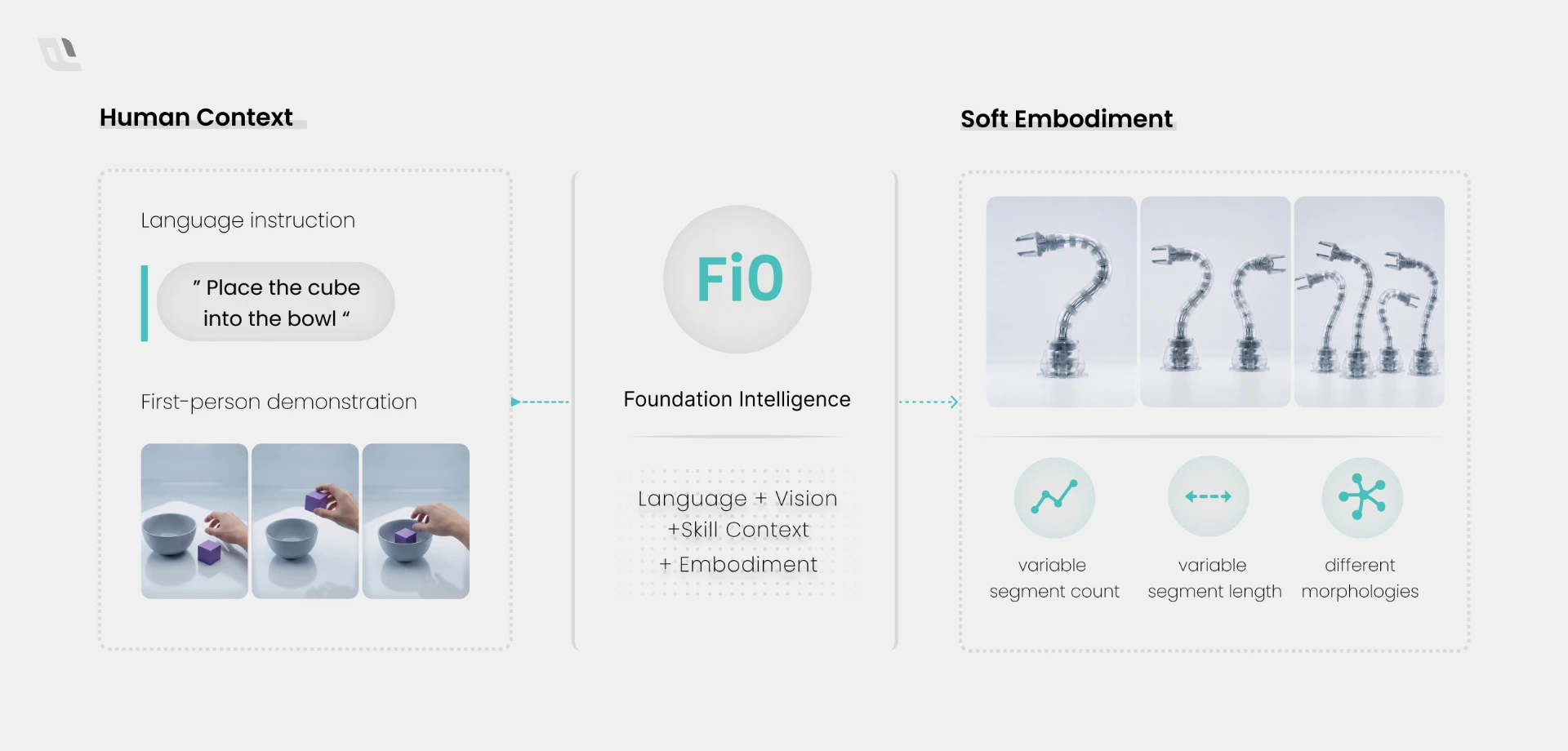
Fi0 treats language, vision, human demonstration, environment state, and robot embodiment together as context for the model. Language describes task objectives, vision and environment state provide information about the current world, and embodiment representation describes what body the robot is using; when existing training does not cover the current task, a human demonstration can also serve as skill context, supplying new task information to the model during inference.
This means Fi0 must solve two related but distinct problems at the same time: understanding what needs to happen in the physical world for a task, and determining how the current body should make it happen.
Learning Skills from Context
Most robot skills are still acquired through training. When encountering a new task, it usually requires collecting new robot data and then writing that experience into model parameters through training or fine-tuning. For robots in the open world, this pipeline is difficult to scale to the continuously emerging new tasks and novel manipulation combinations.
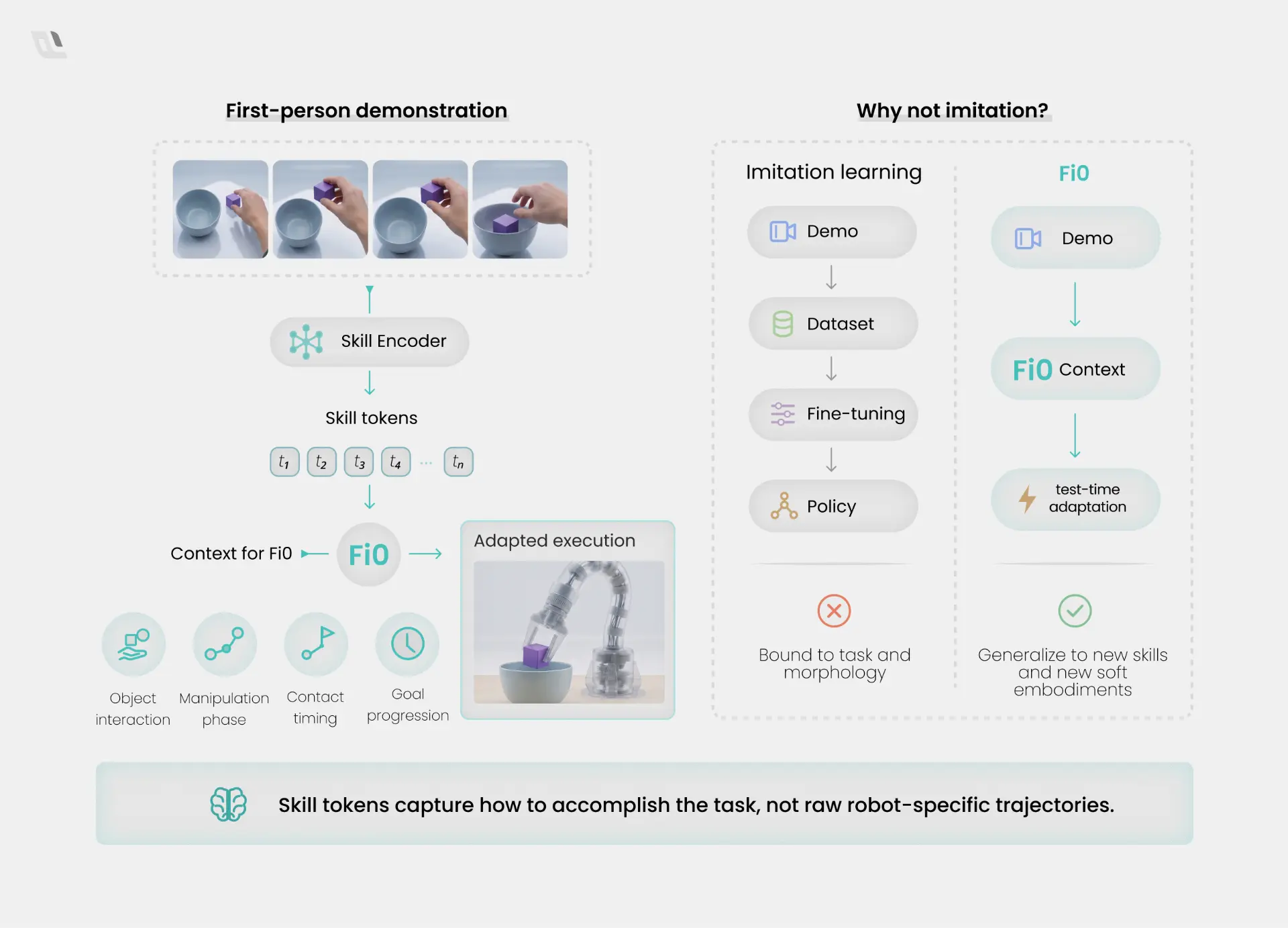
Fi0 therefore turns part of skill acquisition into a context learning problem. For tasks already within the model's capabilities, Fi0 can generate actions directly from language instructions and current observations; for tasks not directly covered during training, a human demonstration can be fed into the model as additional context at inference time, without first completing a new parameter update for that task.
The key here is not to map human motion trajectories onto robot trajectories. A single demonstration simultaneously contains information about object selection, task order, state changes, contact establishment and release, and the final goal, while the specific hand trajectory is just one realization of these task constraints on a human body. Fi0 encodes the demonstration as skill context, enabling the model to extract information about task structure and interaction process, and then generate actions based on the current environment and robot embodiment.
This representation is particularly suitable for cross-embodiment learning. A cup needs to be grasped stably, a drawer needs to be moved from closed to open, an object needs to end up at a designated location; these goals and physical relationships can be shared across robots, but the way human hands, two-finger grippers, dexterous hands, and soft robotic arms achieve them differs.
Therefore, the same demonstration does not need to define a standard action trajectory for all robots. It provides context about the task, while the specific actions are still determined by the current robot.
One World, Many Views
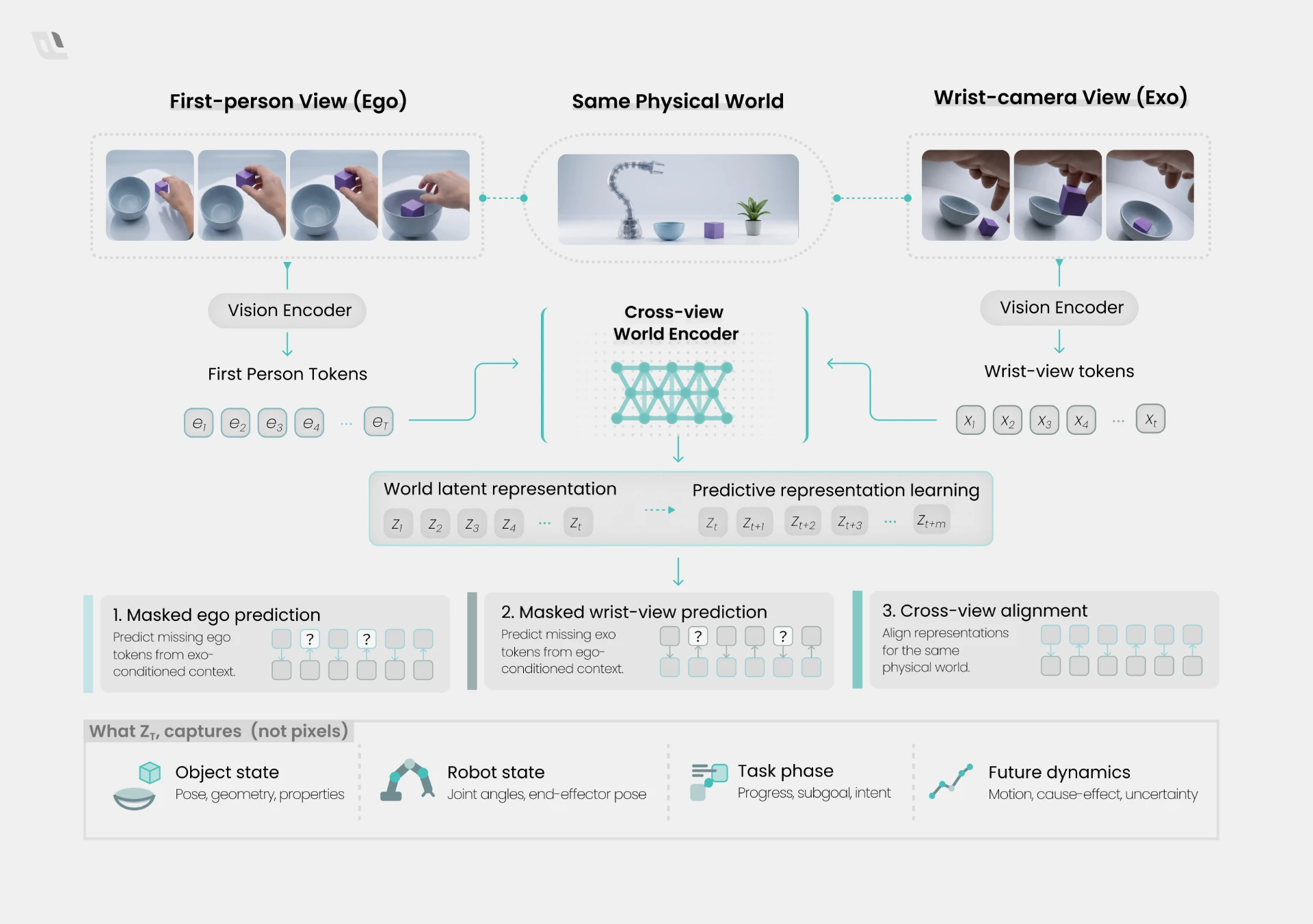
Cross-embodiment learning also means cross-view learning.
Human demonstrations are usually recorded from a first-person perspective, capturing the operations the robot needs to learn. The robot that actually performs the task, however, may observe the environment through wrist-mounted, head-mounted, onboard, or external cameras. Even when two robots perform exactly the same task, differences in camera position, field of view, motion patterns, and body occlusion can lead to large distributional differences in the visual input they receive.
Fi0 builds connections between these observations through cross-view learning. The model does not require direct pixel-level correspondence between the human first-person view and the robot view; instead, it learns relatively stable world information from different observations of the same physical process, including object state, spatial relationships, contact events, task stages, and possible future changes.
For example, when an object is lifted from a table, a first-person view and a wrist-mounted camera record two different videos, but the changes—the object moving from rest to motion, the robot transitioning from separation to contact with the object, and the task progressing from an approach phase to a manipulation phase—belong to the same physical event.
By letting different viewpoints jointly constrain the model's representation of these events, Fi0 aims to reduce the binding between skills and specific camera configurations, and allow experience from humans and different robots to enter a shared world representation.
This is also why human demonstrations can become part of the robot's context: the model does not need the robot to see exactly the same image as the human; it needs to understand that both are interacting with the same physical world.
Embodiment as Context
Sharing world knowledge does not mean ignoring body differences. For robot control, the body determines what actions the model can take and what physical results the same control intention will ultimately produce.
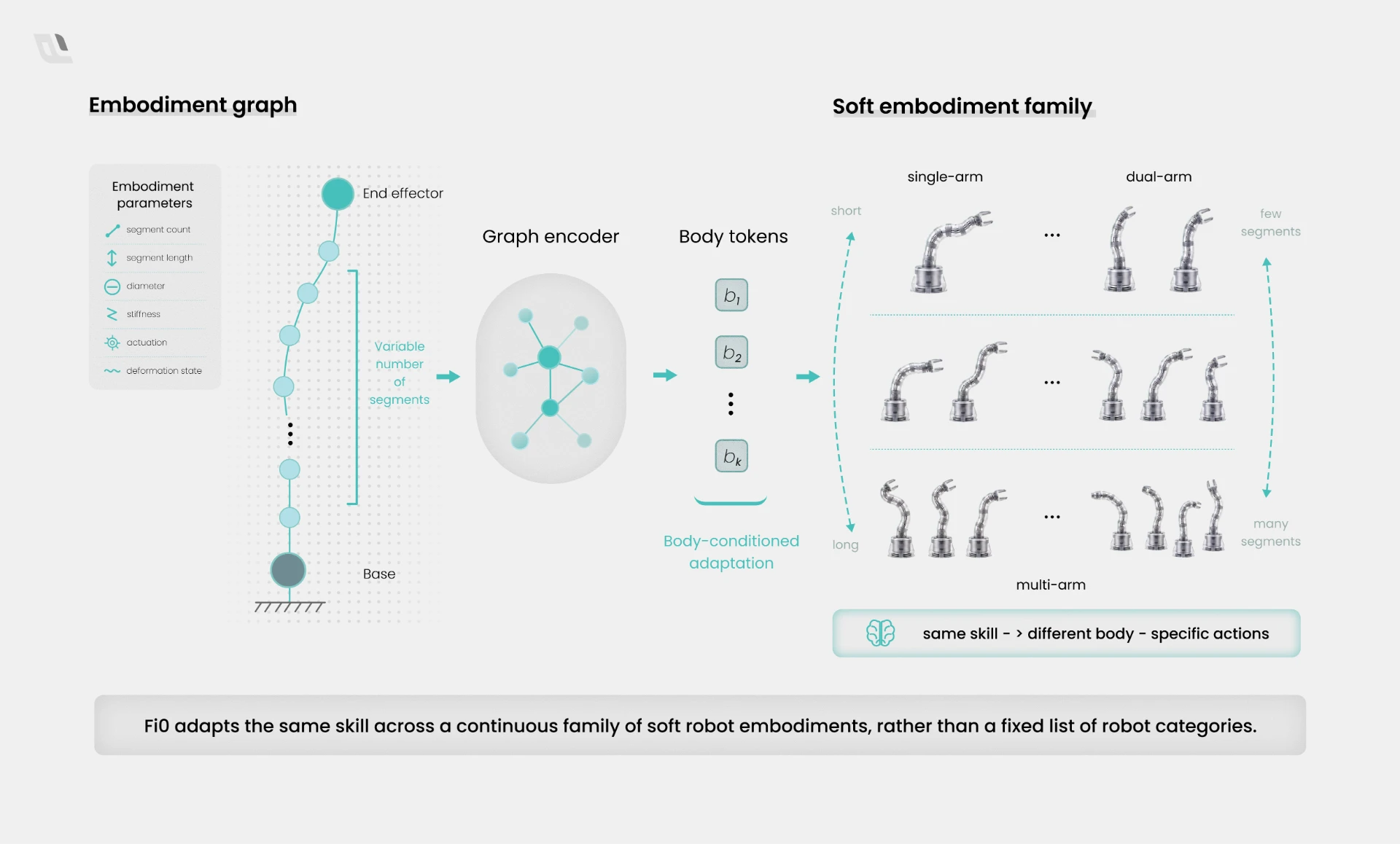
Fi0 uses the robot embodiment as an explicit conditioning input to the model. A structured embodiment representation describes the robot's kinematic topology, joint and geometric structure, sensor configuration, end effector, actuation method, and action-related dynamic states, making action generation conditional on the current body.
This design allows task representations and action representations to play different roles. The model can share knowledge about objects, task stages, and interaction relationships across different robots, while forming different control sequences based on each robot's own reachable space, degrees of freedom, actuators, and dynamics.
Therefore, cross-embodiment does not require building a unified geometric action space that all robots use. Fi0 is more concerned with learning the conditional relationships between task, world state, embodiment, and action: when the task goal and environment remain the same but the body changes, what actions can still produce the required results.
In this framework, embodiment is no longer just a robot ID in a dataset. It becomes part of how the model understands action capability.
Flexible Embodiments
Soft robots provide a special testbed for studying this relationship.
For traditional rigid robots, different embodiments usually appear as a few discrete platforms: six-axis arms, seven-axis arms, dual-arm systems, or different types of end effectors. The body differences of soft robots can extend further into continuous space. Different platforms and configurations can have different lengths, segment counts, stiffness, and actuation methods, and during an actual execution the morphology of the soft structure itself also changes continuously.
This means embodiment is no longer just a fixed piece of information the model receives at the start of a task. The robot's current morphology and body state continuously affect reachable space, contact geometry, and action response; the same control goal may need different implementations under different body states.
Fi0 currently uses Feagine's single-arm, dual-arm, and multi-arm soft robots to study this problem, and incorporates structural parameters and dynamic body states of soft embodiments into the embodiment condition. We hope to study whether the model can learn continuous structure about embodiment from multiple robots and many body configurations, rather than only switching discretely among a few known robots.
Soft robots are therefore an important research platform for Fi0 right now, but they do not define Fi0's boundary of applicability. Instead, we see them as a more rigorous cross-embodiment setting: if a model can maintain task knowledge while body structure and morphology keep changing, and adjust behavior according to new body conditions, that capability should also help the model adapt to a broader range of robot platforms.
Predicting the Consequences of Action
Embodiment change affects not only what actions a robot can take, but also the consequences of those actions. Even when two robots try to accomplish the same task, similar control strategies can produce completely different outcomes due to differences in geometry, contact, or dynamics.
Fi0 therefore not only generates actions, but also predicts the world after the action.
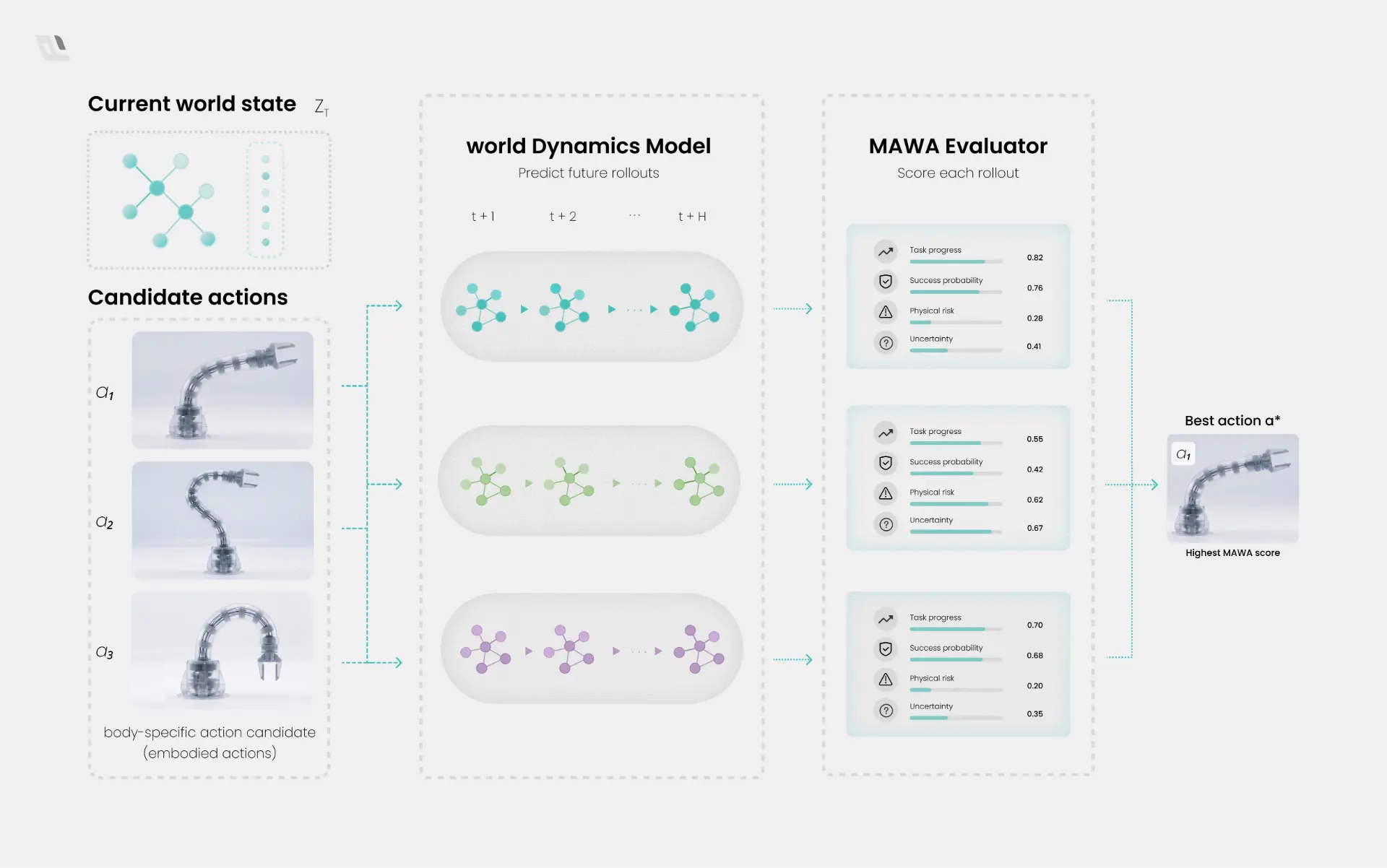
The World Dynamics Model (WDM) conditions on the current world state, robot embodiment, and candidate actions to predict the future states these actions may lead to, including object motion, contact relationships, and changes in task progress. Future prediction enables the model to understand and compare actions based on the results they cause in the world, rather than relying solely on the similarity between the action itself and training trajectories.
On this basis, Multi-Objective Action-World Assessment (MAWA) evaluates candidate futures. Different candidate actions can be compared in terms of task progress, probability of success, physical risk, and model uncertainty, and the evaluation results are used for subsequent action selection.
This mechanism is especially important for cross-embodiment. When different robots face the same task, they can generate different candidate actions, and the WDM predicts the future each of these actions would produce under the current body conditions. What the model ultimately needs to maintain consistency is not the form of action, but whether the action pushes the physical world toward the correct goal state.
World understanding therefore serves not only perception. Modeling the future directly enters the control loop.
Foundation Intelligence Across Embodiments
Fi0 studies context learning, world representation, embodiment conditioning, and future prediction under a single problem: how much of the knowledge a robot has already acquired can continue to be used after tasks, viewpoints, and bodies change.
New demonstrations can expand the task context available to the model at inference time; visual experience from humans and different robots helps the model build a shared representation of physical processes; more robots and body configurations enlarge the space in which the model learns about embodiment; and the successes, failures, contacts, and recoveries produced during real robot execution further provide experience between actions and physical outcomes.
As these experiences accumulate, the model needs to gradually learn to distinguish which regularities belong to the task and the world, which constraints come from the current body, and how the two jointly determine the next action.
This is also the common starting point for Feagine in building soft embodiments, robot data, and foundation models. A new embodiment is not only an additional piece of hardware on which to deploy the model, but also an additional way to observe and act upon the physical world; new data is not only an increase in task quantity, but also an increase in experience of how different bodies interact with the environment. When these experiences can be jointly leveraged by the same model, adding one more robot no longer means learning a completely independent control system from scratch.
Future robots will not have only one form. Manufacturing, logistics, laboratories, homes, healthcare, and extreme environments have different requirements for scale, force, precision, compliance, and mobility, so robot bodies are likely to remain diverse for a long time.
Fi0 is Feagine's first step in this direction. We hope to build a foundation intelligence that can continue to expand with physical experience, so that task and world knowledge can be reused across different bodies while concrete actions always adapt to the robot that is performing the task.
This is what we call Foundation Intelligence Across Embodiments.